China Best PU Foam Sealant Supplier for Global Buyers
Choosing the best PU foam sealant supplier in China requires more than comparing prices. Global buyers need stable performance, clear documentation, and dependable communication. A professional supplier should understand construction, insulation, window installation, and industrial sealing requirements. Experience matters when products face different temperatures, humidity levels, and application tools.
Small details often reveal real manufacturing capability. Ask about foam density, expansion ratio, curing time, adhesion, and storage life. Check whether each batch has traceable production records. Technical data sheets, safety data sheets, packaging specifications, and sample support should be readily available. A reliable factory can explain how its PU foam sealant performs on concrete, brick, metal, wood, and PVC. It should also discuss nozzle design, gun compatibility, can pressure, and carton protection during long-distance shipping.
Performance must be verified.
A sample may work well in a warm warehouse but behave differently on a cold jobsite. Buyers should test adhesion, yield, curing, and cuttability under actual conditions. Supplier audits, production inspections, and independent testing can reduce uncertainty. Certifications are useful, but they should match the destination market and product application. No supplier fits every project perfectly. That is an uncomfortable but important point. Even experienced buyers can overlook transport temperature or installer habits. The strongest partnership combines factory expertise, honest limitations, responsive after-sales support, and continuous product improvement. This guide explores the practical factors global buyers should consider before selecting a China PU foam sealant supplier.
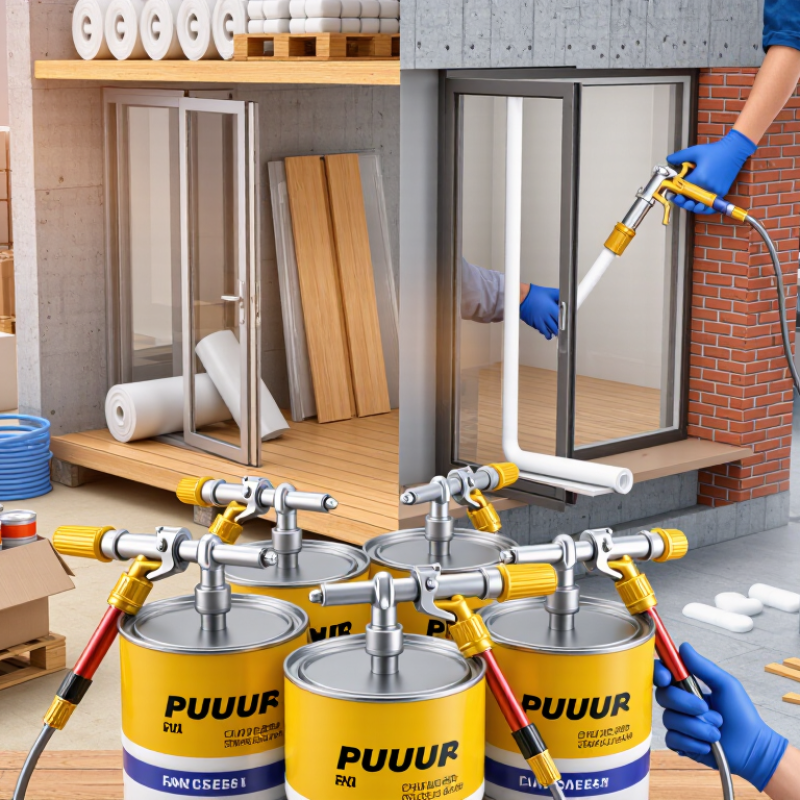
PU Foam Sealant Fundamentals: 1K Chemistry and 15–30 kg/m³ Density
China Best PU Foam Sealant Supplier for Global Buyers
PU Foam Sealant Fundamentals: 1K Chemistry and 15–30 kg/m³ Density
One-component polyurethane foam cures through moisture in the air and surrounding surfaces. The reaction begins inside the can, then continues after application. A 1K formula needs balanced humidity, not simply more water. Excess moisture can create irregular cells, while dry conditions may slow curing.
Density matters during product selection. A cured density of 15–30 kg/m³ commonly supports lightweight filling around window frames, door joints, and service penetrations. Lower density expands further but may show weaker dimensional stability. Higher density usually improves cell strength, though it can reduce yield. Measure the cured core, not the uncured can contents. That detail is often missed.
According to EN 17333-1 testing guidance, cured foam performance should be assessed through density, expansion, adhesion, and dimensional stability. The 2023 UNEP Buildings Global Status Report also identifies building energy demand as a major efficiency concern, making controlled air leakage increasingly important. In practical factory checks, technicians should record can temperature, substrate moisture, bead width, and curing time. A 20°C can and a lightly damp surface may behave very differently from a cold can in winter. We still see inconsistent results.
Density alone does not prove quality. Evaluate cell structure, adhesion, post-expansion, and cutting behavior together. A reliable supplier should provide batch records and test conditions.
Performance Benchmarks: 40–60 L Yield per 750 mL Can and 24-Hour Cure
For global buyers, a 750 mL PU foam sealant can should deliver 40–60 liters of expanded foam under controlled conditions. This benchmark depends on temperature, humidity, nozzle design, and application speed. At 20–25°C, one can may produce consistent output with steady pressure and a clean valve. Colder cans usually expand less. That matters on site.
Professional testing should record free-rise yield and practical yield separately. Free-rise testing measures maximum expansion in an open container. Practical yield reflects gaps, joints, and irregular surfaces. A 40-liter practical result may be more useful than a 60-liter laboratory figure. Applicators should shake the can thoroughly and apply narrow layers when filling deep cavities. Overfilling can waste material and distort frames.
A 24-hour cure claim also needs clear conditions. Many formulations become tack-free within minutes but require a full day for deeper curing. Concrete moisture, air movement, and bead thickness can change the result. A simple inspection checks firmness, adhesion, and residual softness after 24 hours. I have seen acceptable surface curing hide a softer center. That mistake deserves attention. Buyers should request batch test records, storage guidance, and results from both yield and cure evaluations before approving regular shipments.
China Best PU Foam Sealant Supplier for Global Buyers
Performance benchmark for a standard 750 mL can: expected foam yield ranges from 40 to 60 liters, while the reference curing period is 24 hours.
Supplier Verification: ISO 9001, Batch Traceability, and EN 17333 Testing
China Best PU Foam Sealant Supplier for Global Buyers
Supplier Verification: ISO 9001, Batch Traceability, and EN 17333 Testing
Global construction chemical demand is growing steadily. Grand View Research valued this market at about USD 78.6 billion in 2023. For PU foam sealant buyers, supplier verification cannot rely on product photos or polished brochures.
ISO 9001 certification is a useful starting point, not final proof. The ISO Survey 2022 recorded more than 1.2 million ISO 9001 certificates worldwide. Buyers should verify the certificate number, scope, issuing body, and expiry date. A factory should also provide controlled procedures for raw material checks, mixing, filling, curing, and complaint handling. Paper is not proof.
Batch traceability must work backward and forward. One canister should connect to its production date, raw material lots, filling line, operator records, and inspection results. Ask for a sample batch record. Check whether retained samples exist. Trace it backward.
EN 17333 testing adds technical confidence. Request test reports covering density, expansion, dimensional stability, water absorption, and mechanical performance, according to the relevant parts. Results should identify the tested formulation and batch. Generic laboratory reports are weak evidence. Independent laboratories provide stronger assurance, although testing costs can affect quotation prices.
A practical audit should inspect nozzle fit, valve sealing, curing behavior, and storage conditions. Temperature matters. So does transport time. Some suppliers may pass one laboratory test but lack consistent production control. That uncomfortable gap deserves attention. Supplier approval should combine documents, factory evidence, fresh samples, and repeat testing.
Global Compliance: REACH, VOC Limits, CE Documents, and ASTM C1536
For global buyers, PU foam sealant compliance starts with traceable chemistry, not a logo on the carton. REACH records should identify substances, registration status, restrictions, and supply-chain responsibilities. ECHA’s 2023 enforcement project inspected 2,407 products across Europe. It found non-compliance in 18% of cases. That figure exposes a practical risk: incomplete declarations can delay customs clearance or project approval.
VOC control needs a destination-specific test plan. Limits differ between countries, building categories, and indoor-air schemes. A serious supplier should provide emissions data, test conditions, curing time, and stated units, such as milligrams per cubic metre. “Low VOC” alone proves little. The 2024 Global Status Report for Buildings and Construction reported that buildings consumed 34% of global energy in 2022. Material selection therefore carries increasing environmental pressure, even for small aerosol products. Practical testing still has gaps.
CE documents require careful interpretation. CE marking applies only when the product falls under relevant European legislation and an applicable harmonised standard or assessment route. Buyers may request a Declaration of Performance, safety data sheet, technical file references, and accredited test reports. ASTM C1536 can help verify spray polyurethane foam yield under defined conditions. It does not replace REACH evidence or prove CE eligibility. Supplier files often look complete, yet fail to connect each test result with a specific formulation, batch, or market requirement. That weakness deserves review.
China Best PU Foam Sealant Supplier for Global Buyers - Global Compliance: REACH, VOC Limits, CE Documents, and ASTM C1536
| Compliance / Technical Dimension | Reference Requirement or Typical Value | Recommended Evidence for Global Buyers | Buyer Verification Point |
|---|---|---|---|
| Product Type | One-component, moisture-curing Polyurethane foam sealant supplied in an aerosol can; commonly used for filling, sealing, insulation, and installation gaps. | Technical Data Sheet (TDS), Safety Data Sheet (SDS), packaging specification, and intended-use statement. | Confirm whether the product is gun-grade, straw-grade, or available in both formats. |
| Density of Cured Foam | Typically approximately 10–35 kg/m³ for conventional one-component PU foam; the declared value depends on formulation and test method. | Lot-specific or product-specific TDS and laboratory test report. | Check the test method, specimen preparation, and whether the value is free-rise or in-joint density. |
| Yield | Typical nominal yield: about 20–45 L per 750 ml can, depending on temperature, humidity, application method, and expansion control. | TDS with declared yield basis and batch test records. | Do not compare yields unless can size, application temperature, and measurement method are equivalent. |
| Tack-Free Time | Common commercial range: approximately 5–15 minutes at around 20°C and 50% relative humidity. | TDS and controlled-condition test report. | Verify the defined endpoint for “tack-free” and the stated environmental conditions. |
| Cutting / Trimming Time | Often approximately 30–90 minutes under standard conditions; thick sections, low humidity, and low temperature can extend the time. | Application guide, TDS, and test report. | Confirm whether the stated time applies to a specific bead thickness. |
| Dimensional Stability | Low-expansion formulations are commonly selected for window and door installation to reduce pressure on frames; the allowable change must be declared by the manufacturer. | Dimensional-stability test report and installation instructions. | Request the declared expansion class or percentage and the applicable test conditions. |
| Application Temperature | Many all-season formulations are specified for approximately 5–35°C; winter formulations may be rated for lower temperatures. Exact limits are product-specific. | TDS, can label, and storage/application instructions. | Separate can temperature, substrate temperature, and ambient temperature requirements. |
| REACH Compliance | For EU supply, assess chemical substances under Regulation (EC) No. 1907/2006, including applicable registration, restriction, communication, and Substances of Very High Concern (SVHC) obligations. | EU-compliant SDS, REACH declaration, SVHC statement, and restriction assessment. | Check the current ECHA Candidate List date and verify whether any article or packaging obligations apply. |
| Diisocyanate Training Requirement | Under EU REACH restriction entry 74, industrial and professional users of products containing diisocyanates at or above 0.1% by weight require appropriate training before use. | Label statement, SDS Section 15, formulation declaration, and user-training information. | Confirm the applicable concentration and the required training module for the intended market and use. |
| VOC Requirements | VOC limits are jurisdiction- and product-category-specific. There is no single worldwide VOC limit for all PU foam sealants; applicable rules may include EU, national, regional, or project specifications. | VOC test report stating the method, result, units, and regulatory category; SDS Section 3 and Section 15. | Identify the destination country and exact product category before declaring compliance. |
| VOC Reporting Basis | Results may be reported as g/L, g/L less water and exempt compounds, percentage by mass, or emissions concentration; these units are not interchangeable. | Accredited-laboratory report with sampling and calculation details. | Match the test method and reporting basis to the buyer’s local regulation or green-building specification. |
| CE Documentation | CE marking is not automatically required for every PU foam sealant. It depends on the intended use and whether the product is covered by applicable harmonised construction-product requirements or another EU legislation. | Declaration of Performance (DoP), Declaration of Conformity where applicable, technical documentation, and notified-body or assessment records when required. | Verify the exact legal basis; do not accept a generic CE logo without supporting documents. |
| Construction Product Documentation | For construction applications, documentation should identify intended use, declared performance, reaction-to-fire information where relevant, and applicable assessment or testing route. | TDS, DoP if applicable, fire classification report, and installation instructions. | Ensure the declared use matches the actual application, substrate, and installation method. |
| ASTM C1536 Reference | ASTM C1536 should be treated as a buyer-specified standard reference only after confirming the current edition, title, scope, and applicability to the PU foam sealant being purchased. | Test report naming the complete ASTM designation, edition year, laboratory, specimen preparation, and result. | Do not substitute a general ASTM test report for a report performed to the requested ASTM C1536 scope. |
| Fire Performance | Cured PU foam is combustible unless a specific fire-rated formulation and tested system are provided. Fire resistance is system- and joint-design-dependent. | Relevant fire-test report, classification report, and approved joint or assembly details. | A “fire-rated” claim must identify the tested configuration, joint dimensions, substrates, and validity limits. |
| Adhesion and Compatibility | PU foam generally adheres to common mineral substrates, wood, and many metals, but adhesion to polyethylene, polypropylene, silicone, and some treated surfaces may be poor without specific preparation. | Substrate compatibility data and application guide. | Require project-specific adhesion testing for coated, damp, contaminated, or unusual substrates. |
| Packaging and Transport | Aerosol PU foam cans are commonly classified for transport as dangerous goods because they are pressurised and may contain flammable propellant; classification depends on formulation and transport mode. | Current SDS, dangerous-goods classification, UN transport information, carton specification, and pallet plan. | Confirm sea, road, air, and destination-country requirements separately before shipment. |
| Shelf Life and Storage | A typical unopened shelf-life declaration is 12–18 months when stored upright in a cool, dry location; the actual period is product- and packaging-specific. | Batch coding policy, storage instructions, and shelf-life declaration. | Set a minimum remaining shelf-life requirement at shipment and inspect can valves and seals. |
| Quality-Control Package | A practical export quality package includes incoming-material control, batch traceability, fill-weight checks, valve-function checks, yield testing, appearance inspection, and retained samples. | Certificate of Analysis (CoA), batch release record, inspection checklist, and retained-sample policy. | Request lot number, production date, expiry date, and matching test records for each shipment. |
Buyer Selection: MOQ, Incoterms, Shelf Life, and Climate-Range Testing
China Best PU Foam Sealant Supplier for Global Buyers
A reliable supplier should make MOQ clear before quoting price. A small MOQ reduces inventory pressure, but may increase unit cost and packaging waste. Larger orders can improve batch consistency and freight efficiency. Ask whether mixed colors, valves, or formulations count toward the MOQ. This detail is often overlooked. Request a written quotation with production lead time, sample policy, and batch documentation.
Incoterms define more than the delivery point. They assign freight, insurance, customs, and risk responsibilities. Compare FCA, FOB, CIF, and DDP only when the included services are identical. A low CIF price may exclude destination charges. Confirm who handles export clearance and damaged cargo claims. Your forwarder should review the commercial terms before payment.
Shelf life deserves practical attention. Check the manufacturing date, remaining usable life, and recommended storage temperature. Do not accept vague phrases such as “long shelf life.” Store cartons away from sunlight, moisture, and heat during transport.
Climate-range testing should reflect the installation site, not only laboratory conditions. Test curing, adhesion, expansion, and nozzle performance at low temperature and high humidity.
Repeat testing after storage aging when possible. Some buyers skip this step to save time, then face slow curing on cold projects. That choice deserves reconsideration. Ask for test methods, acceptance limits, and traceable batch records before approving production.
Article Source:
Contact Us
We offer a just-in-time delivery solution supplying the highest quality materials to our customers. Get in touch today and learn how we can help your company.
Get in touch